
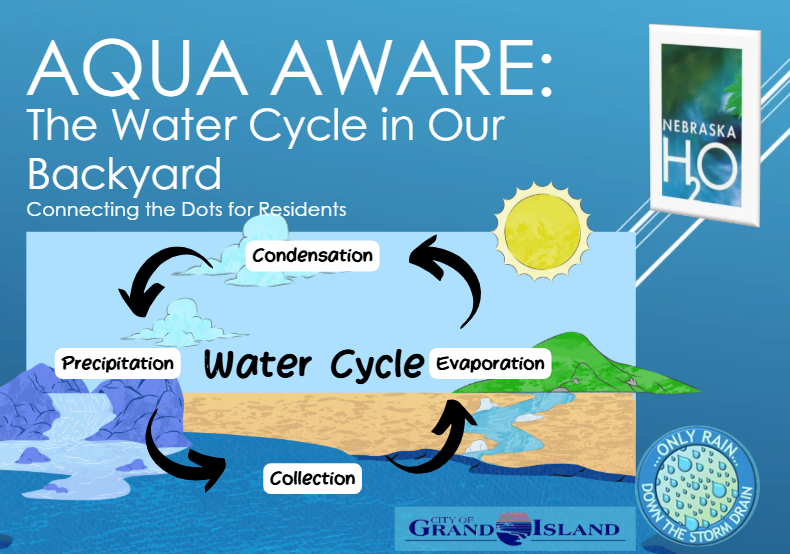
Most of us learned about the water cycle in school: water evaporates, forms clouds, falls as rain, and repeats the process.
What many people do not realize is that the water cycle is happening all around us every day—in our neighborhoods, parks, lakes, rivers, and even beneath our feet.
Understanding the water cycle helps explain why stormwater management, groundwater protection, and water quality matter in Grand Island and across Nebraska.
1
Water Rises Into the Air
The water cycle begins when water is warmed by the sun.
Water evaporates from:
• Rivers and streams
• Lakes and wetlands
• Soil
• Lawns and gardens
• Puddles after a storm
Plants also release water vapor through a process called transpiration.
Together, evaporation and transpiration move water from the ground into the atmosphere.
2
Clouds Form
As water vapor rises, it cools and condenses into tiny droplets.
Those droplets gather to form clouds.
Eventually, the droplets become large enough to fall back to Earth as precipitation.
3
Rain Falls on the Community
When rain reaches Grand Island, every drop takes a different path.
Some rain falls on:
• Lawns
• Gardens
• Parks
• Native landscapes
Here, much of the water can soak into the soil.
Other rain falls on:
• Roofs
• Streets
• Parking lots
• Sidewalks
Because these surfaces cannot absorb water, rainfall becomes stormwater runoff.
4
Water Move Across the Landscape
Once rain reaches the ground, it has two primary options:
It can soak in, or it can run off.
Water that infiltrates into the soil helps recharge groundwater.
Water that runs across hard surfaces enters storm drains, ditches, lakes, wetlands, streams, and rivers.
As runoff travels, it can pick up pollutants such as:
• Pet waste
• Fertilizers
• Grass clippings
• Sediment
• Automotive fluids
Because stormwater is generally not treated before reaching waterways, pollution prevention starts where rain falls.
5
Groundwater Mingles With Surface Water
Much of the water that soaks into the soil continues moving downward through layers of earth and sand.
Eventually, it becomes groundwater.
Groundwater supplies drinking water for much of Nebraska and helps sustain rivers, lakes, wetlands, and streams during dry periods.
In Central Nebraska, groundwater and surface water are closely connected.
The Platte River can recharge groundwater, and groundwater can help feed rivers and streams.
Water is constantly moving between these systems.
6
The Cycle Continues
Whether water falls on a rooftop, flows through a storm drain, soaks into the soil, enters a river, or becomes groundwater, it remains part of the same cycle.
Eventually, that water evaporates again and the process begins anew.
Why It Matters
The water cycle connects everything.
The water leaving your driveway today may eventually reach a lake, a river, groundwater, or another community downstream.
That is why everyday actions matter.
Picking up pet waste, using lawn chemicals responsibly, planting native vegetation, improving soil health, and reducing runoff all help protect water as it moves through the cycle.
The water cycle is not something that happens somewhere else.
It happens in our neighborhoods, our parks, our rivers, and beneath our feet every day.
Our Water, Our Responsibility.