
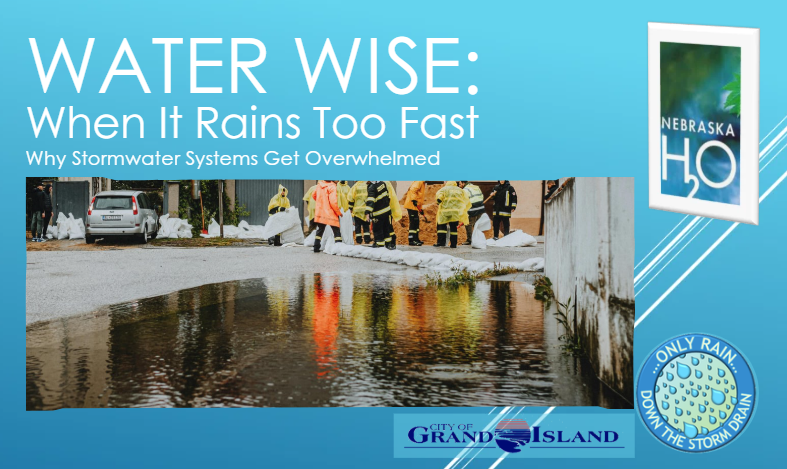
A summer thunderstorm rolls through. Within minutes, water is ponding at intersections, running over curbs, or collecting in low spots around town.
The first thought is usually, “A storm drain must be plugged.”
Sometimes that’s exactly what’s happened.
Just as often, though, everything is working the way it was designed. There’s simply more water arriving than the system can carry all at once.
Stormwater Systems Aren’t Built for Every Storm
Grand Island’s stormwater system includes thousands of inlets, miles of underground pipe, roadside ditches, culverts, lakes, and detention basins. Together, they move rainwater away from streets and neighborhoods to reduce flooding.
Like any piece of infrastructure, the system has limits.
It’s designed to handle the storms we expect to see, not every possible rainfall. An unusually intense storm can produce more runoff than pipes and channels can move at one time.
When that happens, water has to wait its turn.
It’s Not Just How Much Rain Falls
A slow, steady inch of rain is very different from an inch that falls in twenty minutes.
The total rainfall may be identical, but the stormwater system experiences them very differently.
When rain falls faster than water can enter storm drains and move through pipes, runoff begins to collect on the surface. That’s when streets, parking lots, and low-lying areas start to fill with water.
The system hasn’t stopped working. It simply can’t move water as fast as it’s arriving.
Picture a Funnel
Imagine pouring water into a funnel.
Pour slowly, and everything drains without a problem.
Dump the whole container at once, and water backs up until the funnel catches up.
Stormwater systems work the same way.
Once the rain eases, the system continues moving water downstream and those flooded areas usually begin to drain.
Why Water Sometimes Stays in the Street
It may seem strange, but some streets are designed to temporarily store water during larger storms.
That temporary ponding helps protect homes and businesses by keeping excess water out of buildings while the drainage system continues working.
It’s usually safer for a street to hold a few inches of water for a short time than for that water to end up inside someone’s living room or basement.
As downstream pipes, ditches, and channels regain capacity, the water gradually drains away.
Detention Basins Help Take the Pressure Off
Those grassy basins that sit empty most of the year become important during heavy rain.
They temporarily store runoff that would otherwise rush straight into the storm drain system.
Grand Island also uses permanent ponds and sand pit lakes as part of its stormwater network. During a storm, they provide additional storage while slowing the flow of water moving downstream.
None of these features eliminate flooding, but they reduce the peak flow moving through the system at one time. That helps protect neighborhoods farther downstream.
More Pavement Means More Runoff
Before development, much of the rain that fell on the landscape soaked into the ground.
Today, rooftops, driveways, streets, and parking lots send much more water into the stormwater system.
Modern developments are required to include stormwater controls that help offset those changes, but even well-designed systems can be challenged by unusually intense rainfall.
Sometimes It Really Is a Blockage
Leaves, grass clippings, sediment, and trash can reduce the amount of water a storm drain can accept.
A partially blocked inlet may cause water to back up sooner than it otherwise would.
That’s one reason it’s important to keep debris out of streets and gutters, especially before rain is in the forecast.
Still, even a perfectly clean storm drain has a limit. During the biggest storms, there may simply be more water than any inlet can handle.
What You Can Do
You can’t control the weather, but you can make it easier for the stormwater system to do its job.
- Keep leaves, grass clippings, and trash out of streets and gutters.
- Sweep debris instead of washing it into storm drains.
- Direct downspouts toward lawns or landscaped areas when appropriate.
- Consider a rain garden or other practices that help water soak into the ground.
- Report blocked or damaged storm drains to Public Works.
When thousands of properties slow runoff just a little, the benefits add up across the community.
Why It Matters
Stormwater systems are built to manage rain, not eliminate every puddle or every flooded street during every storm.
When rainfall arrives faster than water can move through the system, temporary flooding is sometimes unavoidable.
That doesn’t always mean something is broken.
It often means the storm is simply bigger or more intense than the system was designed to handle.
The more we can slow runoff, keep storm drains clear, and give water places to spread out and soak in, the better the entire system performs when the next heavy rain arrives.