
Most people look at a storm drain and assume it connects to a treatment plant somewhere downstream.
A place where water gets cleaned.
That’s a reasonable guess. It just isn’t how the system works in most cases.
Stormwater usually isn’t treated after it enters a storm drain. Water moves through a network of pipes built to carry the water away from homes and properties, not clean the water.
Here’s what actually happens.
Water enters the storm sewer system
Rain falls on streets, parking lots, driveways, sidewalks, and roofs. As it runs off these surfaces, it picks up whatever is there—soil, leaves, oil, litter, or fertilizer.
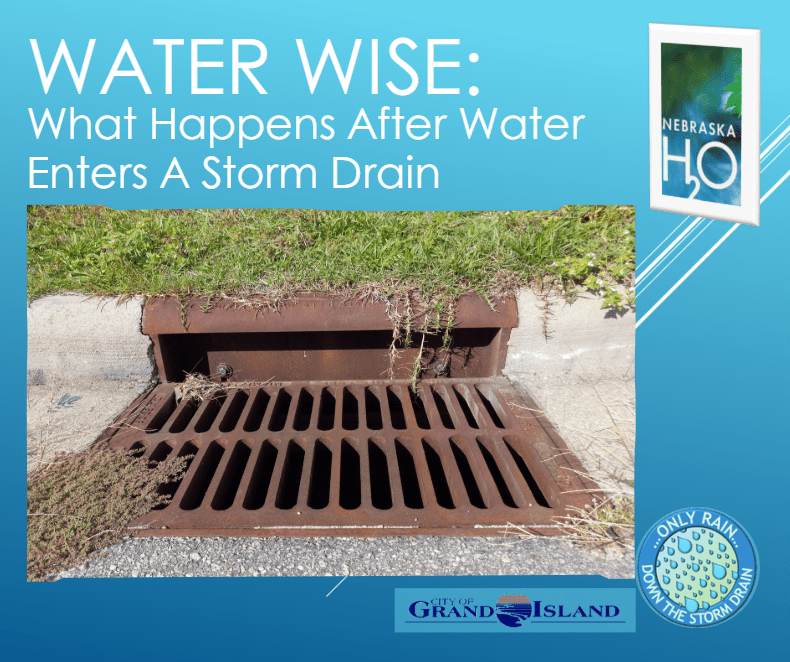
That runoff water flows toward the nearest inlet, usually a curb opening or metal grate in the street.
Once it disappears down that drain, it’s in the system.
It moves through pipes and ditches
From the inlet, stormwater enters underground pipes, open ditches, culverts, and drainage channels.
The job of this network is simple: move water out of developed areas so streets don’t flood.
There is no cleaning step. No filtration plant. No holding tank for treatment.
Just movement. Rapid movement.
It travels through the city
As water moves, it connects different parts of the community—neighborhoods, parks, low areas, and drainage corridors.
Along the way, it can pick up more material already in the system:
-
- Sediment
- Grass clippings and leaves
- Trash and debris
- Nutrients and organic matter
What starts in one yard doesn’t stay there for long.
It reaches lakes, creeks, and rivers
Eventually, stormwater leaves the pipe system and enters natural waterways.
In Grand Island, that includes local creeks, lakes, and ultimately the Platte River system and connected downstream waters.
At that point, it’s no longer in engineered infrastructure. It’s part of the environment.
The key difference: no treatment step
This is the part that matters most.
Stormwater is not typically treated before it reaches waterways.
Wastewater is different. It goes to a treatment plant. Contaminants are removed and clean water is released.
Stormwater doesn’t pass through that process. It moves directly from streets to streams.
That’s why what enters a storm drain matters so much.
Why this matters
Because there’s no treatment step, pollution has to be prevented at the source.
Once material enters the storm drain system, it moves quickly and is difficult to remove.
That includes:
A small amount of pollution from one property grows quickly when each property adds to the pollution.
How this connects to flooding
Stormwater systems are built to carry water, not debris.
When sediment or trash accumulates in inlets, pipes, or ditches, capacity for water drops. Water has fewer places to go.
That can lead to:
- Street flooding during heavy rain
- Slower drainage after storms
- Standing water in low areas
Keeping storm pathways open helps the system do its job.
Why there isn’t a stormwater treatment plant
It comes down to timing and space.
During a storm, huge amounts of water arrive all at once. Capturing all of it in real time would require huge pipes in every part of the city and another treatment facility just for stormwater.
Instead, communities focus on a different approach:
- Prevent pollution before it reaches the drain
- Use infrastructure that slows and filters runoff where possible
- Reduce contaminants at the source
What you can do
Stormwater moves fast. Prevention is where the impact is.
Simple actions help keep the system working:
-
- Sweep driveways and sidewalks instead of washing debris into the street
- Pick up pet waste
- Keep leaves, grass, and soil out of gutters and inlets
- Dispose of chemicals, oil, and household waste properly
- Report blocked storm drains or standing water
Each one reduces what enters the system during a storm.
Why it matters
Storm drains aren’t endpoints. They’re the starting point of a much larger system.
What enters them moves through pipes, ditches, lakes, and rivers connected across the landscape.
That’s why stormwater protection doesn’t start downstream. It starts where the rain hits the ground—and where it enters the drain.
Clean water isn’t something that appears at the river.
It’s built upstream, one storm drain at a time.